Saturday, 7 May 2022

Conversations I've been having in London

The first real conversation I had in London was unsurprisingly about the weather at the Airport. After waiting for a good 2 hours for the Uber in a mix up, I remarked to some passengers in the car park that it was quite cold. They emphatically said no. Gosh, how sensitive can you be about the English weather. Just by wishing it is warm doesn't make it warm, no? 

During my brother's wedding reception, I was told by one of my brother's friends about the government's plan to dump asylum seekers in Rwanda which he didn't agree with. You miss watching/reading news for a bit and miss so much. 

This really makes me start questioning the adoration and adulation we have for Paul Kagame, as a strong man who result Rwanda after a horrific civil war and genocide. I've personally seem him as a great leader who brought stability, unity, a national vision, and real economic growth with a couple of decades. Compare that to Liberia which has been ruled by an international projection of democracy and beholden to donors. Liberia has achieved nothing in the 2 decades since the end of the civil war and pretty much stands where it 'started' in 2003. The liberal market democracy pushed by neoliberalism has resulted in a hollowed out state that depends on international NGOs to deliver social services.  They were hoping for an economic boom that would start funnelling rents to another small elite with reopening the country to global capital but they fell flat on their faces when mining companies pulled out when global commodity prices tanked and palm oil plantations too have not been able to grab as much land as they could. For all these reasons, I've been watching Rwanda's economic progress, stability with interest and combined with my lived and academic understanding, it's clear that national vision and growth are not dependent on the mockery of changing presidents through the election cycle. 

I met with with a SOAS classmate after a long time. She hails from Argentina and her father was in politics, leftist politics I believe. She is an activist her self so you can imagine how rich my conversations with her are. This time, I shared with her what I learned from grassroots feminism in Pakistan. These are some highlights of our talk: 

"How many women were in the Aurat Azadi March"? 

"About 1000 in Islamabad and may be 4000 or 5000 in the bigger cities." 

"What, we get millions on the streets in Latin American. Our network is much stronger." 

"I am not very clear about why socialist feminists idealise communism when it has failed. " 

"Communism may have failed in Cuba because people are very poor but it has been successful in China. China is a successful communist state which lifted people out of poverty and has created prosperity. Moreover, foreign companies have only 50% ownership in China and the other 50% has to be locally held." 

This conversation stayed with me for long. Why are feminist movements bigger and stronger in Latin America? Is it because liberation politics has had a longer time to breathe there? After all, Latin America decolonised earlier and has been through civil wars, Cold War proxy wars and military dictatorships. Also, I think the way we are conditioned to see China is too far entrenched in Western liberal ideas. 

What else? I'll list snippets here in bullet form: 

- Very little recycling is done in London and most of the garbage gets shipped away to other countries

- There is a worker shortage in the UK (Brexit)

- The Tories are awful

Monday, 2 May 2022

Monday, 4 April 2022

What to do with the youth?

Spoke to consultants researching the market for a youth project that will train women and men in business skills and then , stick them into companies for apprenticeship projects. I am familiar with such programming both at the UN as a donor reporting officer and, as an entrepreneur. I am surprised that the analysis coming from international donors and partners remains the same and isn’t deeper in terms of where the economy is at. From my own historical knowledge: this methodology was implemented in the DDRR programme and, ex-combatants were trained in vocational skills at pre-war institutions like BWI and, YMCA and then, either given toolkits or stuck into organisations for internships. A few years later , I hired two young women as apprentices through an American NGO implementing the same type of youth project. What I have learned ? The whole burden of absorbing apprentices falls on the organisation which might just be grooming them for better opportunities. In an ever stagnant economy like Liberia, what kind of investments are really needed to create employment ? Also from what I gather, very little solid investment has been made into educational and vocational institutions. Instead these pre-war institutions have to compete to win training contracts driving a capitalist ethos rather than creating permanent quality institutions. Thinking outside the international development nexus, when one looks around in the urban centre of Monrovia, the youth that is thriving has built small-scale businesses themselves despite the challenges of having no electricity, poor infrastructure, no support from the state, corruption, etc. This is where the analysis should start, not from a vacuum. Policymakers should come up with programming at a deeper level that reflects the current dynamics. 

Saturday, 19 March 2022

In my next life I'd like to come back as a European consultant in Africa

How many times have I offered my knowledge , expertise and lived experiences in Liberia to roving consultants in Liberia? I can't count the number of times. Enough is enough.  

I'm infuriated because my opinions and knowledge are freely consumed to benefit international consultants who often times have never lived/worked in Liberia or even the region yet, somehow landed consultancies. 

I'm getting supremely annoyed by this. Is this development? And who is being developed? Salary bank accounts or who? 

Moreover, it seems that the donors are driving the same recycled agendas concerning youth, education, health, capacity building, governance, what have you. NGOs and these interesting characters called contractors (which USAID uses) respond to these thematic calls by writing the same proposals over and over again. 

Just recently I donated more than 2 hours of my time to a meeting with not 1 but 3 consultants who wanted to know how my business could use youth trained by their project. 

I hired 2 such apprentices for our company a few years ago through another similar programme implemented by an American NGO where I worked at a few years ago. I have applied several times for a Youth project at this NGO (where I incidentally worked before) demonstrating my knowledge and expertise in the area of business, management and development (an intersection which few folks have) and failed to even get an interview. 

I am livid at this system.  

So, I actually hired 2 young women in good faith through this Youth programme, wanting to play ball with the system. I lost one of the apprentices to a higher-paying NGO after putting in years of time training her from scratch. I am glad she is better paid but it seems the development agency is merely appropriating everything in its self-serving mission. 

Both Haresh and I were shocked with the shallow analysis and level of discussion: 

1 ) But how many people were trained by that American NGO (no clue and instead advised to go look at the USAID website)?

2) What lessons were gained from that and similar previous projects? 

3) How integrated is this project with the state and its structures? 

4) Does the youth really need bookkeeping skills ? Marketing skills? 

5) How many Liberians are self employed in small businesses ? Carpentry? Tech repairs/services ? Mechanics? Tailors? Salons? Masons? Do you have such numbers? 

6) What is the economic weather ? What are the market conditions? Is this what is really needed right now? 

7) Do small businesses need capital and state support or a 3-month workshop in bookkeeping? 

8) There is such a big informal economy in Liberia where both men and women are doing small business to survive? Is lack of bookkeeping keeping them back? What analysis have you done there? 

9) Why should established businesses continue to employ apprentices , train them from scratch, support them, absorb them in our business so your project can succeed and look good for your final report? 

10) Which institutions will you use to train the youth? The ones they listed are all pre-war institutions like BWI or YMCA (which I know from my DDRR days and these same institutions were used by the same agencies to train ex-combatants). Has any investment been done in these institutions ? Have you all helped to build world-class facilities? Do these institutions have stable electricity? Do they have qualified world class instructors and teachers?

11) How many jobs are even out there?  

The obsession with youth and their potential for violence and attempts to distract them from their own frustration and anger at their own condition is one of the core pillars of development policy. This youth is being gobbled up by right wing political waves from Trump's America to Modi's India to militarised and mullazied Pakistan. This youth is hurling abuse at the Black Lives Movement. This youth is voting for Brexit. This youth is refusing to be vaccinated. This youth is selling socks in wintry Islamabad in December. This youth , often time university degree-ed, is driving cabs in the Gulf. This youth is selling biscuits on the streets of Monrovia. This youth is cooking and selling food on the streets of Monrovia. This youth is lynching Muslims in India or poor Christians in Pakistan.  The right wing states and powers distract this youth while chances to get a piece of an ever shrinking pie are getting slimmer. And what do policymakers have for them? Little small workshops in bookkeeping and business skills so they might learn how to do business which might then help feed them. 

I am frustrated and angry at so many levels. The development industry's analysis of socio-economic conditions is extremely shallow and predicated on such artificial capitalist short term assumptions. But it is also severely hypocritical and racist. In more developed countries, the state as a minimum has to invest in youth through quality education, education and vocational institutions which have decent facilities, stimulus for small businesses , decent healthcare and functioning infrastructure. What do they do in poor countries? 

They want youth to give up their time away from making money to feed themselves to participate in workshops to learn how to add columns and write reports for a few weeks, throw them at businesses for free and, then claim they supported the youth. Not only is it patronising but so disingenuous. 

International development is so short term and so devoid of structural analysis. They are not interested in building or supporting structures. They are not interested in ensuring structures are permanent. Everything revolves around pimple-faced consultants flying through , whirlwind meetings and workshops. Everything can be solved by these geniuses. And, everyone agreeing to giving them a free ride.

To this, last night at a lovely party, my cynical artist friend who is going back to his home country in Europe because nothing works and things aren't really improving : "In my next life I'd like to come back as a European consultant in Africa." 

My father played with snakes

Humans of Monrovia. Meet Willie Kalli. 

"Where did you learn painting from?"

"My bossman who died. I've been doing it for 20 years. I'm a Lofian. I never went back since the war. My mother and father died and my one sister is here and the other one is in Lofa. I don't have a mother or father. I got to work so I can eat. I have 2 children but cannot have more children. Too expensive. I need money. Not easy. My father was Kalli and played with snakes. He was a great man."


Wednesday, 9 March 2022

Bats in the sky and a hill

Seeing the bats in the evening sky on top of Snapper Hill is one of my favourite things to do in Monrovia. All the noise, all the trash, all the chaos and stress disappears on top of this hill where many other Monrovians have come for their own moment of peace and exercise. 

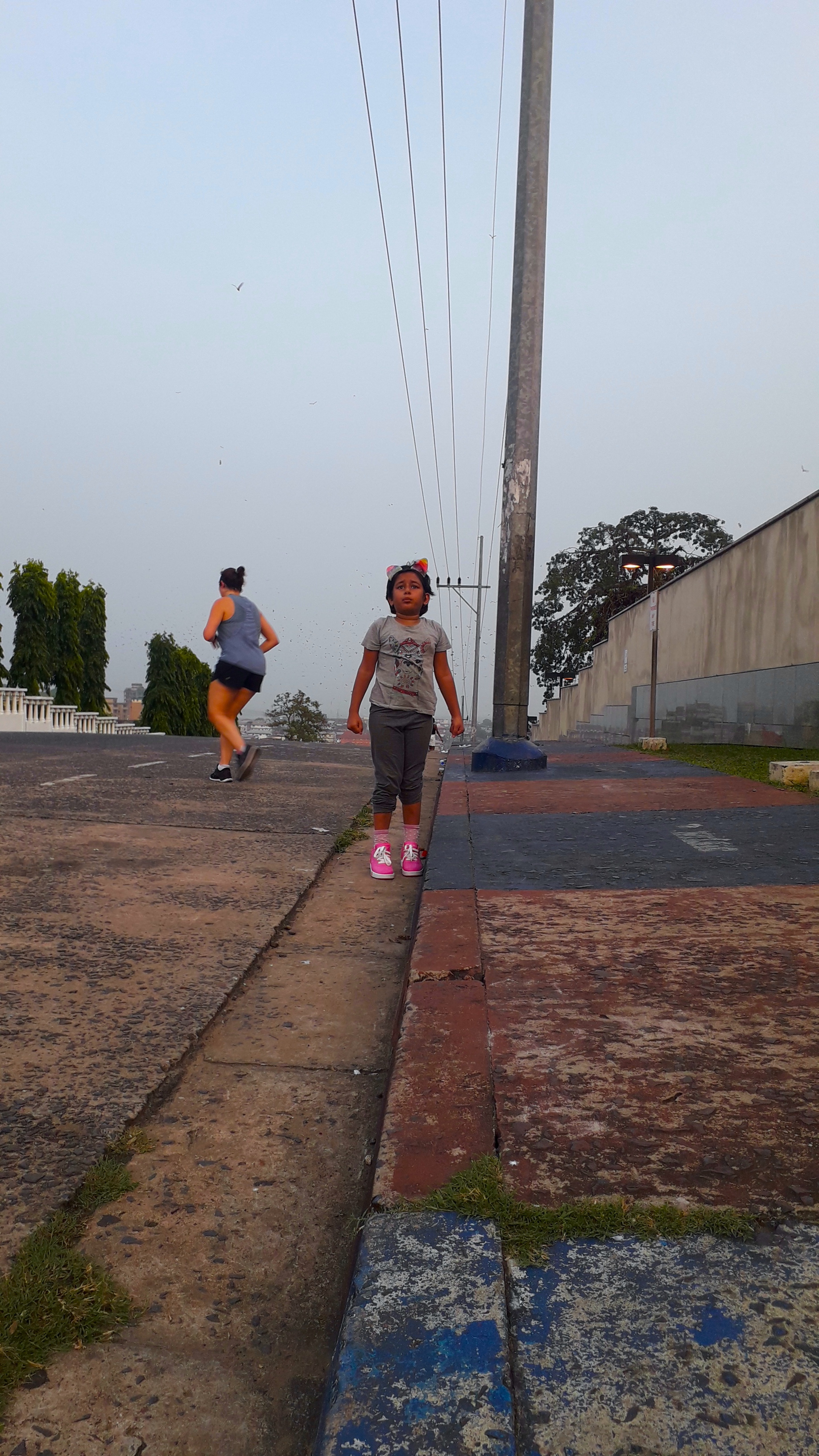
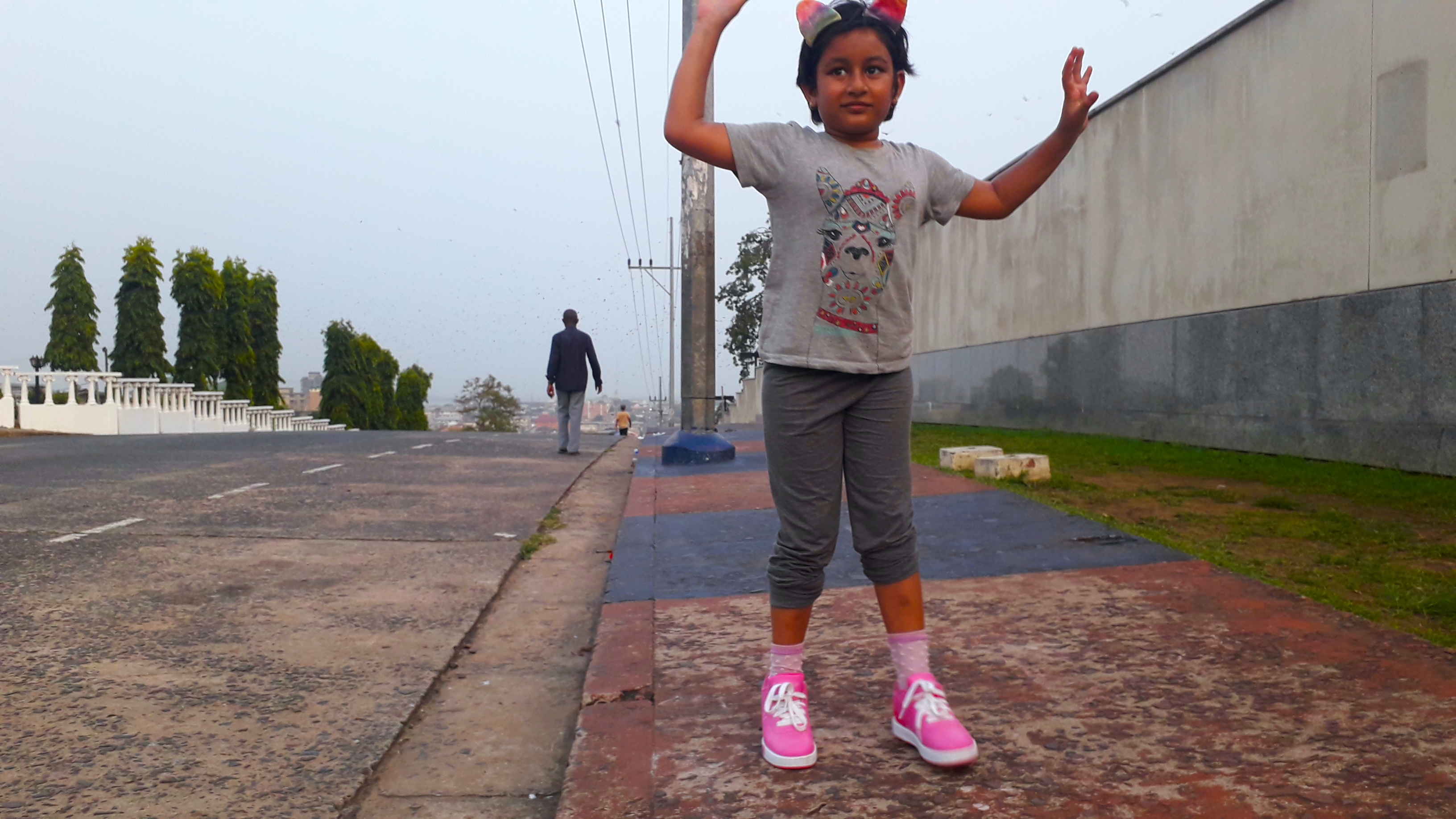
Kavita tried her Heelys and, she's still terrified of them. She fell badly back in Islamabad and, here , too, she fell down. I tried to help her but still she was scared of them. What to do? 


Monday, 7 March 2022

Feminist Eid

Kavita and I are away from Islamabad for Aurat Azadi March but there in full spirit. My journey as a feminist includes nurturing and training of Kavita as one, too. She and I made our own posters showing mother and daughter in our own feminist space.  


Wednesday, 2 March 2022

How many lies are too many?

Coming back to Monrovia after a 3 year gap has been deflating and discouraging. It's been a crash landing and, the plane has still not come to a complete full stop. 

The almost-2-hour ride from RIA to central Monrovia is enveloped in complete darkness at night. Crashing into another vehicle with broken headlights at night on the RIA Highway is a recurring what-if nightmare and, to experience this road after an exhausting series of flights from abroad is a terrible way to come back. 

They are widening the Highway which is good, but meanwhile, you have to come through this depressing darkness , riding for hours, hoping not to have an accident, if you flew in at night. 

When you finally make it to the edges of Monrovia, you will see an insane an amount of traffic on the same small road, chaos, some lights, garbage, even fully visible at night. From the edge of Congo Town all the way to central Monrovia, everything was dark, hardly a few street lights here or there. 

If you aren't a saving-the-world international development worker, living a humble life in a fully serviced compound, you will arrive in a house or apartment building which is yet again dark. If you are lucky enough to have a back up generator, you can have that turned on and, then sit and weep , wondering what you are doing in a country which doesn't have electricity. 

Not having stable electricity has been the bane of my existence here. I'm getting close to my mid-40s so I'm really not a fan of living like this. 

But, we have to pretend like everything is good. So good that 200 years of Liberia's history was being marketed and celebrated in a grand style. There are - or rather, still are, and will be there, rusted, for next 10 years -  hoardings everything talking about this grand event. I believe some of these hoardings mention a Monrovia that is green and clean. 

Speaking of cleanliness, Monrovia is filthy. It is exponentially more filthy than before I left. There are mountains of garbage on Centre Street. I literally exclaimed in horror when we passed by it. 

The controversial 'Monrovia is the dirtiest capital' comments by the EU Ambassador which I'd seen on my Facebook feed started to make sense. 

The state celebrated 200 years of existence by a very grand event at the SKD Stadium, attended by dignitaries from neighbouring states and the United States of course. In fact, the celebrations were launched end of last year, marketing the Bi-Centennial celebrations as Year of Return, copying what Ghana has more successfully done, attracting African Americans 'back home.' Ghana though is far more advanced as an economy and has thriving sectors and markets compared to Liberia. 

Liberia has already implemented the 'returnee' policy in its earliest post war era under Ellen Johnson Sirleaf. Many appointments in administration were made to Liberian diaspora but how many of these professionals actually returned? Everyone talked about how the merely channeled their salaries back to the US where they still had rents and school fees to pay. 

From what I understand with Ghana is that the Diaspora is welcomed back to live and work. I am not sure how many appointments are being made in its state infrastructure, at least not critical ones. Ghana is a much more thriving and stable economy but I can't imagine who wants to come back to Liberia given that literally nothing works. 

And more, importantly, these Bi-Centennial celebrations are hollow if they don't engage with Liberia's problematic past and, the contradictions of the 2003-present post-war era. And, they haven't. It seems it's all been pomp and glory. That this particular populist, anti-establishment , anti-elitist government has promoted such a narrative points to the supremacy of power and that of the state. It is vital to keep promoting a grand narrative of Liberia as a free and unique state for black people and, the symbolisms of the first independent republic, despite its horrific history as a settler colony, have to be perpetuated at all cost. Not even a from-the-slum-footballer-turned-President is going to tinker with this image. So, we keep playing this tune and even amplify the notion of freedom so much so that we continue to be a beacon for return to the continent. 

See this piece: CONFRONTING DUPLICITY Liberia bi-centennial celebration: why it needs to reconcile history and identity. 

In the midst of this grand farce, the price of produce knocked me out. I couldn't believe that a rather small pineapple costs 700 LD! 4 mangoes which literally fell off a tree cost 200 LD. 4 bananas cost 100 LD. Shitty, over ripe bananas. There is no cultivated fruit in Liberia. They all fell off a tree. I'm livid. 

Everything is so damn expensive and nothing works. 

But somehow we have to participate in the falsehoods of narratives, the lying propaganda that state machineries and hegemony operate with. How many lies are too many? 

Thursday, 24 February 2022

If you think about it : what are so-called Western clothes?

If you really think about it, Western clothes are not cultural clothing representing any specific ethnicity or nationality. If you really think about it, what we refer to as Western clothes such as pants, shirts, skirts, T-shirts, jeans, are really mass - produced capitalist products. When we rail against Western clothes in order to attack Western culture or apparent lack of values and ethics despite that there is no single Western culture, we are blindly railing against mass-produced clothing. If you really think about it, before factories came along and tailors and fabric shops were chucked out, clothing was hand made. Of course, if you were wealthy, you could afford silks and satins to make ornate gowns by high-end tailors and, if you were poor, you were making your own clothes as per the cultural traditions of your land. But advent of capitalism must have pushed out hand made clothing and, mass produced clothing became the norm and, now, the fashion industry now is apparently the 2nd or 3rd biggest pollutant. 

In Pakistan, we have started consuming fast fashion like nobody's business. It's everywhere and, so-called sales have started producing frenzied shoppers. Of course, tailoring is still in demand and, everyone still gets clothes tailored for both everyday and Eid and weddings. So, guardians of patriarchy should not be worried that Pakistani women aren't covering themselves in so-called traditional garb. 

In Monrovia, too, tailors are busy busy. Women and men love getting traditional outfits tailored. Lappa material though isn't cheap and, it is obvious only those who can really afford it, can wear beautifully made traditional elegant clothes which beat so-called Western attire any day. It is the public , the street sellers, the dangerous unemployed Liberian youth quote unquote, which is wearing used American clothing. 

I noticed the same thing in Ethiopia during my 2018 trip. During various conversations , I learned that people can't really afford to wear traditional clothing and, what's more, imported clothing was also very expensive. 

I remember seeing women wear polyester saris in Mumbai during my 2019 visit. It showed me that ordinary people simply can't afford good quality traditional fabric. They are far removed from good quality, hand-made fabric in today's modern world. And, they are working in factories making fast fashion for high streets in Europe or their own urban centres which sometimes burn down. 

Patriarchy in the Global South rails against Western clothes for no other reason than to control what women wear. 

Wednesday, 23 February 2022

Feminism doesn't trickle down

Feminism and gender justice don't trickle down when we put women in senior positions in the state or capitalist structures. Liberia is a case in point which elected the first female President in Africa and, has awarded many senior positions to women in its post war era. Liberian women still struggle against sexual violence, poverty, health, injustice, patriarchal norms, etc. It shows what's also needed to bring change: independent grassroots feminism that will challenge the status quo.

I don't know how this phrase came into my mind but I've been thinking about posting thoughts on feminism and activism as March 8 approaches us. I'm happy to be back to my life here in Monrovia (although both the office and apartment locations have changed and I'm adjusting to the new spaces and tropical heat) but I miss Islamabad and the upcoming preparations for International Women's Day.

I met new Pakistani friends at dinner on Friday night (the Pakistani community here seems to be growing fast) and, pleased to meet a fellow feminist albeit she didn't want to say she is a feminist but spoke a thoroughly feminist language. I told her the silver lining of being in Islamabad the past 3 years was the chance to join the feminist movement and learn what it is all about. And, I was inspired by how women are challenging the state, norms, the patriarchy with all their might, their brains , their analysis. That it gives me hope by seeing "kis tarha woh aur hum muqabla kar rahain hain."

I've been following conversations regarding preparations back in Islamabad and keen to see what will be organised here.

I have been thinking about devoting energy to studying independent feminist organisations and activities in Monrovia and indeed rest of Africa after my experience in Pakistan.

Liberia is an interesting case because it enjoyed so much international attention in its post war era but more than that, there was a very strong amazing female-entered narrative: that strong, famous and ordinary women banded together to help stop the civil war and encourage peace talks. And, not only that, great women leaders led the way in the new reformed state that was going to usher in a new era of justice, accountability, peace and equal development. Many women were appointed in senior positions in the Ellen government and, many NGOs sprung up to angle for Western/UN money to work in women's empowerment. Despite all that, Liberian women still suffer and, we still have a vastly underdeveloped country where basic services are still not available and, we are far away from a feminist utopia.

Wealth doesn't trickle down. Neither does feminism!

Thursday, 6 January 2022

Savouring tea and pulao in cold January

What a week....it's been raining since Tuesday! It's been pouring non stop since Tuesday. I checked last year's Calendar where I mark days it rained and things I have to do (yes, I keep a real calendar I hang in my room) and, it rained 2 days straight last year in the 1st week of January but not 3 days at a stretch and, the forecast shows it will rain until Saturday. 


Anyway, Tariq went for a medical check up at Kulsoom Hospital in Blue Area and, Kavita and I met up with him later for a lunch in the area at none other than Savour Foods. 

Not only is the pulao delectable but so is the Savour ice-cream. 

I made a small video at Savour Foods, too. 

Afterwards, I refilled my ink cartridges and, we had a tea at a small café. Why must one have so much tea? And, why is there so much good tea to be found everywhere except in fancy coffeeshops and designer dhabas? As soon as we get up, another one before we take a shower, another one right after lunch, another one to kill the time before dinner and at least a few more before we go to sleep. Tea is everything. 


By the way, Jinnah Avenue will soon be dotted with high rises. Islamabad will look a lot different in the coming decade and, I have a feeling that our views of the greenery and hills is going to be blocked. 


At home, the sun finally showed her face briefly at sunset time. Although it was still very chilly, it was a glorious cold sunset. 


Saturday, 1 January 2022

Shop names

 I spotted two interesting shop names in Islamabad today. 

The Palestini in F-10: 


And, Mallai Mar Kay in G-11 Markaz: 


Which one is your favourite?