Friday, 21 October 2011

I can't see Facebook

Recently, whenever I try to go to Facebook, this is the page that comes up:


It says 'this wiki does not exist.'

I googled Facebook is Being Re-Routed to Wiki and I got 10,400,000 results! Apparently,  being re-routed is pretty common.

The same problem was posted on a discussion on Yahoo! Canada and someone suggested cleaning out all the cookies through running a software which was free for download.


Another blogger posted about Facebook being re-routed to a certain Samuel Garcia's My Space profile. He thought it was because of a "DNS exploit." His advice to issue to open up the Administrator window (on Windows) and issue a command to flush out the cache and to clear out the cookies too. 


Since I am on a Mac and I use the Safari browser, I emptied the cache by clicking on Empty Cache in the Safari drop down menu. Next, I deleted all the cookies (Safari -> Preferences -> Security -> Show Cookies - > Remove All). I typed Facebook again in my browser and it actually worked! 

Thursday, 20 October 2011

It Will Hold


It would be an understatement to say that Liberia has been making history in the past couple of weeks. Two Liberian women shared the Nobel Peace Prize along with a woman from Yemen. One of these women is a sitting head of state who is also hoping to win a second term during one of the most crucial elections in Liberia's history raising questions about the timing of the Prize. Despite a lot of anxiety and worries, the elections were convened peacefully but none of the 15 parties clinched the required 51% of the votes. This was predicted all around and run offs are slated for the 8th of November. Furthermore, the third most successful party has declared its support for the ruling party giving an interesting twist to Liberian politics. The party is led by none other than Prince Johnson, notorious former warlord famous for cutting off Samuel Doe's ear and then proceeding to killing him, now leading a calm life as a born again Christian pastor and Senator from Nimba County.  Finally, it would be noteworthy to mention the good work Liberians in general have done in putting the whole show together as these are the first Liberian-run elections in a couple of decades. The elections were declared FFT (free, fair and transparent) by the host of international observers that have descended into Liberia for these historic elections, including a former Nigerian General. Lastly, history was also made by the Liberia Media Centre for independently providing minute to minute exit polls through their website and social media presence which were actually matched by the National Elections Commission (NEC) results too. 

Prince Johnson, The Queen Maker

Tuesday's BBC article "Liberia's Vote: Prince Johnson Backs President Sirleaf" quoted Prince Johnson as saying Ellen Johnson Sirleaf was "the lesser of two evils." There is something ironic about him using word evil so casually. Not to mention that he comes off sounding very smug because of the sheer sway he knows he could have in these elections. This is a historical juncture where Prince Johnson is able to make such a significant impact on these elections.  

Yesterday's front page headline in the local paper, The Analyst, was "No Permanent Enemy, Only Permanent Interest - PYJ Declares as NUDP Joins Forces with UP." Prince Johnson is described as the "dark horse of the 2011 presidential race" in the article. One can say he's an unpredictable dark horse who joined the opposition in saying that President Sirleaf had not succeeded in reconciling Liberians but now seeing an opportunity, has switched sides. He responded to criticism to his unpredictability by saying "I believe in adaptation base on systems. I tell you exactly what it is and don't mince on words." I am not sure whether he was quoted correctly in the paper or whether that's his English, but ignoring bad syntax, I found his words quite amusing. Sure, he doesn't mince words, he minces ears!


Prince Johnson's choice of words is amusing, witty and reflective of the kind of politics that is being played out in post conflict Liberia since August 2003, when Liberia's 14-year old civil war came to an end through a negotiated peace settlement and peace was ensured through compromise and absent of any criminal accounting. "No permanent enemy, only permanent interest" is an interesting choice of phrase to describe the opportunistic politics that has dominated Liberia since its inception. I am reminded of the slogan that the Liberian population chanted when they elected Charles Taylor to power in 1997 that goes like this: "He killed my pa, he killed my pa but I will vote for him." 

This is a country where following a negotiated peace settlement, the same actors of the civil conflict enjoy positions of power and influence in state and society. In fact, Liberia's post-war justice choices have demonstrated that there is no enemy of the state and, power and interest lead the way. It is almost as if there are not any other options and it is ironic that a famous warlord and singled-out perpetrator by Liberia's Truth and Reconciliation Commission (TRC)'s report is able to go about being so smug and influence these critical elections. It is as if there are no other political options in Liberia except for the same actors over and over again. The 'Congo' elite and former warlords, the so-called sides of the civil conflict, have come together again to control and wield power. So what has essentially changed in this post-conflict scenario, one might ask?

The ignored TRC Report was an important card that was used by the opposition during this campaign season. President Sirleaf has been accused of ignoring the Report which bars her from public office for the role she played in the civil war. She testified in the TRC process herself, admitting she financially supported Taylor and apologised for it. However, the apology was not enough and neither the fact that she was a sitting head of state to whom the Report was presented to; and so, the Report lists her as a perpetrator recommended to be barred from office for 30 years. 

I have heard Liberians say she 'has blood on her hands' or she 'brought war' to this country. This is an interesting perception. Sirleaf has admitted to giving $ 10,000 to Taylor, perhaps it was more than this and even in combination with other kinds of support. Whatever it was, it has been translated into enough of a charge to be considered an actor in the civil conflict. The Report's recommendation to bar her and others from public office and, the Report being ignored has been used fully by the opposition. That is what makes the awarding of the Nobel Prize to a named-perpetrator by the TRC even more interesting. 

The opposition does not have any more of a cleaner past than the President in a post-conflict state where the same actors from the war have found roles to play in the 'new' dispensation. Most notably we have the man at the centre of everyone's attention, the queen maker, Prince Johnson himself. How much cleaner is his past? How has he managed to re-invent himself as a born again Christian pastor and Senator and what kind of public has voted him in as a Senator  and as the leader of his party?      Not only has he been able to make the born-again Christianity work to his advantage but he also continues to present himself as a freedom fighter. 

Now, we have the President having made a pact with Prince Johnson in order to get his support and succeed at getting a second term. What bearing does this having on her distinction as a Nobel Peace Laureate? 

Just before the interesting twist was made by Prince Johnson and before Tubman, the standard bearer for the CDC Party, was hospitalised on shock at losing a key part of the opposition which had declared the results fraudulent (see hilarious picture below), I would have predicted that the TRC Report would be re-opened sooner or later. With how the opposition has used this card during the elections, one would be led to conclude that the justice issues have not died down and in fact, need to be addressed by the new regime, be it Sirleaf or anyone else. At the same time, though, the new turn of events has made me reflect upon how 'transitional justice' issues are tackled in Liberia. They have more or less been dormant in Liberia and the TRC Report has been ignored by locals as well as the international community. Perpetrators of the conflict are enjoying positions of power and respect like the rest of them. And justice issues have only come up to be used in the elections, for the advantage of discrediting the incumbent President.


And now that President Sirleaf has made a pact with the "dark horse," what chance is there of ever opening up that TRC Report and start to address those issues?  

Transitional justice in the form for criminal trials has been demanded by the public, civil society and the international community in other experiences. So far, Liberia's efforts at moving towards criminal justice has failed and it is doubtful that it will change anytime soon. It has more or less been swept under the carpet and it is doubtful that it can be freely addressed. With a Prince Johnson helping to re-crown the Queen, has the transitional justice ship sailed? Or did it sail on 18 August 2003? 

Expectations and Results

These have been exciting elections not so much for any amazing show down between UP or CDC but more so for President Sirleaf's luck and Prince Johnson's queen-making twists. 

The CDC made a smart move by teaming up with Winston Tubman, a former UN diplomat and Harvard educated economist, to deflect criticism away from former footballer George Weah's less than perfect educational and political credentials. However, they were short of any other intelligent strategy after that. In terms of an ideological platform, there's the usual buzzwords like Good Governance, AgriBusiness and Environment. In fact, if you take a look at their website, it's quite unimpressive and reads almost like a UN or World Bank Report on How to Reduce Poverty and Build a Sustainable Environmentally Friendly Gender Friendly Future. They have even incorporated the pillar language into their website which is highly amusing. 

Their campaign has actually been characterised by a lack of imagination and scandals more than anything else. They were unimaginative enough to actually use the same campaign language as the UP. The CDC-ians were labeling themselves baboon, calling the President a corrupt monkey and declared their last major rally as the monkey's funeral. This all came from the UP's campaign slogan "The "Monkey Working Baboon Wait Small."

Winston Tubman has stated that he does not care for civil liberties. George Weah threatened a journalist for taking pictures of his motorcade knocking down a pedestrian. Through out the election season, the CDC and NUDP have been aggressively posturing and even threatening trouble in case the elections did not take place free and fair. And when the elections indeed did not result in a majority for any one party, particularly their party, they cried foul! 

All in all, the opposition, particularly, the CDC lost a great opportunity to play some intelligent and mature politics in these elections. Sirleaf herself lamented the fact that she would not go head to head with George Weah which is a bit of an insult for Tubman because surely, his years of experience as a diplomat and experience has done nothing for his political image thus far: "I'm ready to take everybody on. I think the strongest person is the person who decided not to run for president. And that's unfortunate. But he decided to accept the vice presidency role maybe because he doesn't realise that when people are voting, they will be voting somebody else who is not as popular as he is." ("Weah's Decision Was Unfortunate" in Daily Observer, 10.10.2011)

It is Prince Johnson who has come out of this as a better political player who seized an opportunity when he saw it. 

The run offs and the period leading up to the run offs will be exciting still and I certainly am enjoying this interesting phase in Liberia's history. 

If I dare make a prediction, to borrow a local phrase, "it will hold," meaning that the current regime will come back again and President Sirleaf will enjoy another 6 years of power. With all the honours bestowed on her by the international community and her local political successes, she is going to be written into history books as the mother of the nation, an image that she has been working hard to project.

Sunday, 9 October 2011

The Monkey Wins the Nobel Peace Prize on its Own Funeral Day

The 2011 Nobel Peace Prize was awarded to three women: Ellen Johnson Sirleaf (Liberia),  Leymah Gbowee (Liberia) and Tawakkul Karman(Yemen). This blog entry is a reaction to the timing of the prize to Sirleaf who is up for re-election for a second term. The Committee explained that the elections are a national consideration and their award goes beyond the fact Sirleaf is running for a second term. That sounds all good and noble by recognising that they are awarding the Prize during such critical elections,  but it sounds a bit insincere. The bottom line is that the Prize should not have been awarded in real time. This international stamp of approval will only feed into the perception that the powers that be are calling the shots in Liberia. 

Awarding of the Nobel Peace Prize 2011: Bad Timing?

Friday morning, we all woke up to the stupendous news that not one but two Liberian women had been awarded the Nobel Peace Prize (along with an activist from Yemen, Tawakkul Karman). The winners are the current president of Liberia, Ellen Johnson Sirleaf, who is running for a second term and Leymah Gbowee, a social activist known for leading women in peaceful protests. 

It was a surprise to say the least!, My initial reaction to it was - as usual - suspicous: "Hold on, let's not get too excited here."

Given that elections are hardly a couple of days away, it seems like inappropriate timing. Excited messages have been posted on Facebook and the Liberia Expats Google Group. Among my former colleagues and friends from the UN and NGOs who used to work for Liberia or still work here, it's "congratulations" all around. People are quite chuffed with themselves for having been associated with such a regime and society that is being showered with such praise and respect on an international level. It also reaffirms the ideological framework under which they serve. Hardly anyone from the UN/NGO crowd bothered to question the timing of this Prize. 

Amongst the critical reactions were that that this was being "perceived as interference in the political process." This was observed by a friend (expat) who is working out in Grand Gedeh County.  Another friend, an academic who has published a Phd on Liberia, told me that while he thinks this is great for "global recognition" for Liberia's progress, he didn't think this was "fair for democracy" as it would definitely interfere in the process. Another friend (also works for an NGO) who was over for dinner last night, suggested that the Prize should have either been given earlier to mark the a few years of peace brought about in Liberia or a couple years later.

Further still, given the speculation about these upcoming elections and that this election is going to marked by stiff competition, some think that this Prize is meant to appease Sirleaf and 'encourage' her to leave peacefully in case her party does not win. That the international community is 110% behind Sirleaf goes without saying but that is not how I read the news. I think this just a big fat endorsement.

Although the international press is still seemingly vague, random and selective about details in Liberia's story and how its reported, there is now more of an understanding that Sirleaf's image abroad does not necessarily match her domestic appeal. The New York Times' article Nobel Peace Prize Awarded to Three Activist Women  states: "The Nobel committee’s decision underscored the gap between local perceptions of her — it is not hard to find critics of the president in Liberia — and the view from abroad."

Monkey's Funeral and the Big Cheese

Having discussed the ill timing of the awarding of the Prize and the international community's over excitement in expressing their support for an active politician and sitting head of state, what was the local reaction to the Prize?

Well, the news was not even printed in the local papers and whoever did learn of the news must have through radio. My staff was not aware of it until I told them and since they are all UP (United Party - Sirleaf's party) supporters, instant Facebook messages went up celebrating the Prize.

It was also the day when the Congress for Democratic Change (CDC), the main opposition party, launched a final campaign rally. So I took a walk out on Randall Street to get a sense of what was going on. My staff had told me the day before it was going to be quite rowdy and the CDC-ians were going to make trouble.

It was more like a party atmosphere slash street politics while the businesses were either closed or the owners stood at their entrances observing the show. As I walked towards my friend Bendu's tea shop, I heard animated discussions on both sides of the street by men and women wearing CDC T-shirts. I could hear bits and pieces like "We are not for UP or CDC, we are for Liberia." So I finally got to Bendu's and again, she did not know of the news but a lady, a secretary for a Lebanese businessman, who was getting her hair braided, knew of the news.

A Lebanese fellow who was hovering around started speaking to me and tried to impress me with his conspiracy theories and personal take on the elections. I shall paraphrase it: Africa is a piece of cheese divided among Western powers and Liberia belongs to the Americans. Referring to locals, he said they have no clue what is going on and because neither he or I could vote, who cares? Finally, he said Obama was in support of Winston Tubman (the standard bearer for CDC).

The fellow's crass and patronising remarks prompted a barrage of indignant protests from the women around us. The ladies shot down the gentleman's shaky theory and undiplomatic comments on Liberians' understanding of politics. My friend, the secretary, was so impassioned at the thought that Liberians would let CDC come into power and bring in turbulent times and risk the peace. The guy disappeared but the excited discussion went on for many more minutes.

It made me realise that sure, Sirleaf enjoys immense international support, and is a "darling of the international community" as described by the Washington Post ("Liberia's Nobel Prize-winning President To Face Stiff Competition at Tuesday's Polls"), but she also has a strong domestic following. My staff, mainly composed of youngsters below the age of 30, love and admire her as the mother of the nation. Market women, vegetable and fruit sellers and the average person on the street I have interacted with profess to be UP supporters. Even the few 'returnees' (Liberians returning from abroad after exile) I have befriended are staunch UP supporters. Salaried, office-going people also support UP. I also see avid support and discussion on my Facebook stream. I think that while some of the average people on the street supports her truly as Mama Liberia, the more so-called educated and wealthier layer applies a certain practicality to their support. In other words, many believe there is really no other viable alternative to Sirleaf.

CDC is viewed as populist party with little or no ideological platform which enjoys mass following comprised mainly of a bunch of 'hooligans' for lack of a better word. This perception is very strong among UP or other party supporters. A procession was coming down on Randall Street and I managed to take a few pictures of the crowd. Most of the partisans were young men and women, dancing and singing, drinking and generally having a good time. Apparently, most of them do not have have voter registration. They were singing some songs about a corrupt monkey and its funeral. 

The monkey refers to Sirleaf, actually; moreover, it's self-afflicted! Part of the UP's campaigning involved the slogan "Monkey Still Working Let Baboon Wait Small." It's a playful satire to convince the public to give the current administration a chance to continue its work. Baboons, referring to CDC, are noisy and troublesome. Another billboard says not to change the pilot before the plane has not even landed! Another set of billboards are even more dumbed down: for instance, Education Da Their Area, Agriculture Da Their Area, Hospitals Da Their Area.

So Friday's CDC rally was dubbed the Monkey's Funeral but unfortunately for them, the Monkey was awarded the Nobel Peace Prize!

Tail End 

The upcoming elections in Liberia are going to be historic not only for the country itself but add or subtract from Africa's recent election nightmares. And of course, let's not forget that if Liberia manages to peacefully hold these elections, the international community will be able to pat itself on the back for its neo - liberal peace building efforts in the country since 2003.

I have been quite optimistic about these elections: that Madame Ellen will be swept into a second term, the transition will be smooth, Liberians are 'tired of fighting, ' too much is at stake in terms of foreign direct investment and let's face it, Madame Ellen has the full support, nay adoration, of the international community and it's been fully proven by Friday's announcement of the recipients of the prestigious Nobel Peace Prize.

What will the results be? Your guess is as good as mine. There is some anxiety given the aggressive posturing by the opposition, threatening trouble in case things do not go their way. There is also the likelihood of a run off given there are 15 candidates running for the Presidency. And, there is also a lot of support for the main opposition party, CDC. All in all, these elections will be a tense affair and a lot is at stake.

Tuesday, 30 August 2011

Diss - Dessert - Desert - Elation - Frustration - Desperation - Dissertation


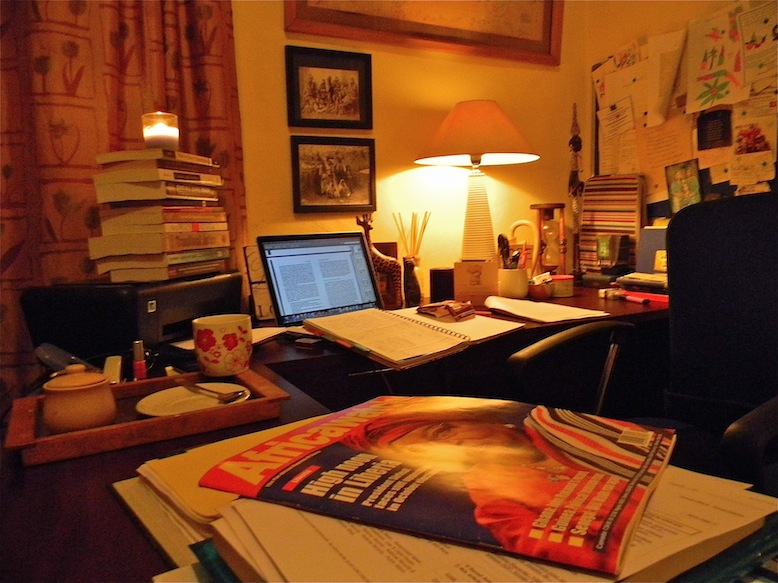
So I am writing my dissertation these days. The working title is "Did the truth commission in Sierra Leone, accompanied by trials, have a substantially different impact from the truth commission in Liberia, with the absence of criminal accounting?" 

I got the idea for the title from the discussion in Neil Kritz's article 'Policy Implications for Empirical Research on Transitional Justice.' (Merwe, Baxter & Chapman: Assessing the Impact of Transitional Justice, 2008) The author is discussing the role of research in policy choices. For instance, he says there is a "clear need...to find ways of disaggregating the different contextual factors and different transitional justice components at play in any particular case." So he suggests the following research question "Did the truth commission in Argentina, accompanied by trials, have a substantially different impact from the truth commission in Chile, with the absence of criminal accounting?" (p.15) 

I took the question and exchanged Argentina for Sierra Leone and Chile for Liberia.  

It is safe to assume that it is not a very sexy title. Some academics really try to be witty and clever and succeed, too:
  • "Truth-Seeking, Truth-Telling, and Postconflict: Curb the Enthusiasm?" 
  • "Homo Economicus Goes to War: Methodological Individualism, Rational Choice and the Political Economy of War"
  • Civil War is Not a Stupid Thing: Accounting for Violence in Developing Countries
  • "The Dark Side of Democracy: the Modern Tradition of Ethnic and Political Cleansing"
  • Not Breaking the Rules Not Playing the Game International Assistance to Countries At War
  • The Dark Side of the Force
  • "A Rational Kind of Madness"
  • Kicking Away the Ladder Development Strategy in Historical Perspective
  • NGOs Beyond the Magic Bullet
  • Surviving Capitalism How We Learned to Live with Market and Remained Almost Human
If academic articles and books were food, their witty titles would be garnishes.  As you can see there's a bit of Stanely Kubrick, Star Wars, James Bond, psychology and pop culture in these titles. Gosh, I never realised how inspirational films can be for academia! 

So, if I want to have a sexier title, I guess I should throw in a classic movie reference, some pop culture and garnish with Latin. I am going to come back on this one. It will be cool to have a less boring title than this one. 

As my friend (also from SOAS who graduated already with a VCD degree) has so eloquently advised me: "These bastards get impressed by the first impression they get and some of them I doubt would read the whole thesis." He was actually referring to the introduction and making it as academically crisp and sexy as possible but I can surely extend this advice to the title too! 

In the meantime, I need to forge on ahead and find out where is the justice in transitional justice. 

Monday, 8 August 2011

Is international or domestic justice blossoming?


I came across an article "International Justice System Blossoms" written by the president of the International Center for Transitional Justice, in the Opinion section of Al Jazeera, hailing the calls of justice across the globe from Cairo to Washington, from Bogota to Kinshasa, from Srebrenica to Colombo. Indeed, we have witnessed in the first part of 2011, 30-year-old dictatorships crumble like dust in a domino-effect across the Arab world that is now being hailed as the Arab Spring.

As Naomi Roht-Arriaza put it: "It has almost become routine. After the shooting stops, or the dictator is deposed, there is the talk of reckoning."

One of the main points of the article is that political and military leaders responsible for gross atrocities are no longer safe from the hands of justice. Impunities will no longer be traded for the sake of peace.

The Ben Ali's and Hosni Mubarak's will have their day of reckoning. In fact, since the arrest of Milosevic, the stage has been set 'for the ICC to issue arrest warrants for Omar al-Bashir and Muammar Gaddafi.'

The author blames regional organisations such as the African Union and Arab League for protecting the leaders mentioned above indicted by the ICC.

In terms of recommendations the author points that trials in Tunisia and Egypt must respect due process and follow the example of former Yugoslavia where trials targeted those 'bearing most responsibility.' Moreover, trials are not enough and other measures are required. 'It is essential the past to be confronted, the truth be told' - it is safe to assume that the author is referring to truth and reconciliation commissions. He also lists reform of the police and military - often referred to as security sector reform (SSR) by practitioners.

The ICC, the author maintains, is there to 'investigate and prosecute a relatively small number of perpetrators.' It exists as a 'backstop to domestic systems lacking capacity or the necessary political will to prosecute the most serious crimes.'

Finally, the article ends on an almost sentimental note - that international justice may arrive late but is inevitable. Bangladesh will apparently address crimes committed during its war of independence from Pakistan. And 'the mothers of Srebrenica waited almost seventeen years for the arrest of Ratko Mladic' and he was recently arrested.

All in all, the author concludes that international justice system blossoms. Like a righteous flower. 

It was quite relevant to read this article as I am currently reading international justice for my dissertation and, I can use this article as a platform to apply what I have read so far. It was also good to see the mention of the trials of reckoning within the context of Arab Spring even though a lot of the transitional justice literature I am reading seems to be discussing transitional justice carried out in societies which experienced collective violence over extended periods of time rather than swift revolutions.

The author is clearly excited about corrupt and evil dictatorships being taken to task amid calls for justice. The title of the article refers to international justice although whatsoever has been achieved in Tunisia and Egypt should rather be called domestic justice.

The author states that 'the demands for justice are today a driving force of social change and popular revolutions'. It made me question and think about whether these revolutions are firstly motivated by justice and change later and, would think that it was rather that the call for change came first and justice followed.

The author greatly emphasises criminal trials as part and parcel of international justice however, from all that I gather from the literature I have read, academics are not even sure of what international justice is and neither what the actual impact is.

International justice can refer to any of the following implemented either stand-alone, in combination of more than one option or all of them together: truth and reconciliation commissions, amnesties, criminal trials, the International Criminal Court in the Hague, hybrid courts, and traditional methods to reconciliation. I guess as long as a 'deeply divided' and very sick society takes any of these bitter but necessary medicines, it will get over the violence and bloodshed it underwent.

Essentially, the critical literature points out that somehow transitional justice - particularly its two main embodiments of truth commissions and trials - has become unquestioned, is implemented based on faith rather than fact and is largely without a sound theoretical framework. The results it claims to achieve such as peace, reconciliation, healing, and consolidation of democracy and rule of law are not necessarily linked to the implementation of trials nor truth commissions. In short, concepts are conflated.

The author of this article tries to make a heroic case for trials however, some academics are not convinced that trials are necessary to consolidate peace and rule of law, satisfy victims or deter future intellectual authors of violence.

There was also a piece I read that explored the impact that transitional justice has on social repair. It asserted that given the collective nature of the violence that grips many states in the post-Cold War context, trials do not challenge bystanders and inaction, communal violence and collective responsibility.

Nevertheless, given the author's conviction that justice can only be achieved by taking to task individuals with the most responsibility, will Western leaders such as Blair and Bush be taken to task for deaths and suffering caused by the Western invasion of Afghanistan and Iraq? And where were the ICC arrest warrants for Mubarak, the head of Egypt, purportedly the highest recipient of American foreign aid after Israel? In short, can international justice be effective if it is selective?

Criticisms of the truth and reconciliation process in South Africa essentially make it out to be a hollow process which not only did not make significant economic reparations to victims but failed to even create a truth record of structural violence and socio-economic inequalities. And, going by this article's stress on trials, would the transitional justice process in SA be considered a failure because of the lack of such trials?

Following in this vein, my dissertation is going to explore this very contradictory translation of transitional justice in the two ill-fated states of Liberia and Sierra Leone, two states with remarkably similar histories and intertwined conflicts. One state implemented both trials and truth commission while the other merely opted for a truth commission. What is even more astounding is that one state has chosen to charge and prosecute the other's former president.

The perpetrators of Sierra Leone's civil war have been indicted and are undergoing trial, most notably Liberia's ex-president Charles Taylor. Not only have Sierra Leoneans prosecuted Sierra Leoneans for war crimes but also the Liberian, ex-president. Sierra Leone has by doing so made an effort towards preventing future war entrepreneurs from rising up and plunging the country into chaos and violence. Liberia on the other hand has not taken this punitive justice route. In fact, Taylor was handed over to the UN to be taken to Sierra Leone when was tried to flee Nigeria where he was in exile. Besides being responsible for taking the war to Sierra Leone was he also not responsible for the civil war atrocities that took place in Liberia? Are those crimes not important? Is Liberia not interested in prosecuting its war criminals? What does the international community have to say for this? How does the court in the Hague reconcile such a contradiction? Do they realise they are judging a trial of a warlord who is responsible for war in two neighbouring countries but yet are prosecuting crimes in only one state? That too of a country that was not ruled by Taylor but where he allegedly exported war. How does the state reconcile this? How do the people reconcile this? According to advocates of trials, then, Liberia is not on the right path to peace building by not holding its war criminals to account. It is not preventing future atrocities. Not only is Charles Taylor, their own former president, being tried for another country's civil war crimes, but other warlords like Prince Johnson are serving in the Senate. Is this transitional justice?

Wednesday, 20 July 2011

One of my favourite things

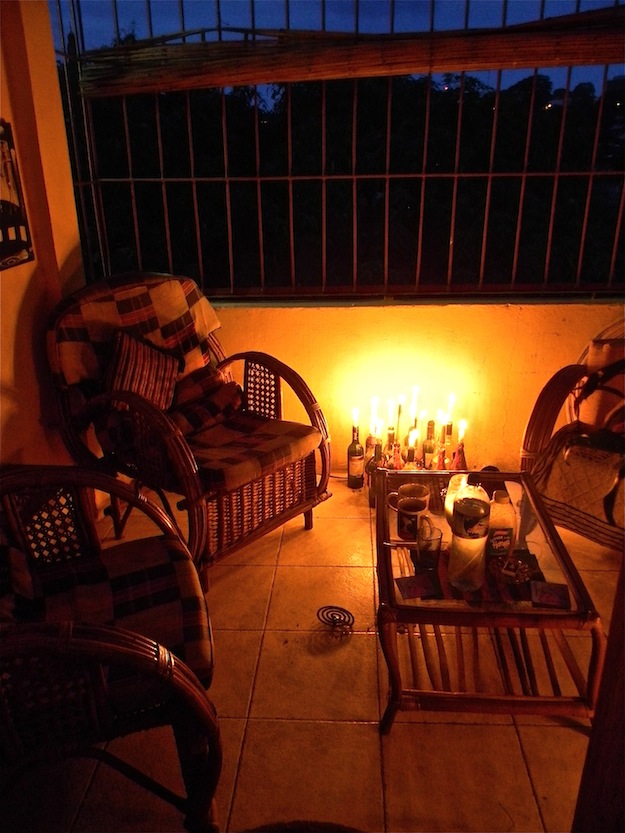
I realised recently that my favourite place in Monrovia is my own balcony! Sure, it's not the sexy sushi bar at the Royal Hotel or the elegant Mamba Point Hotel but it has a certain coziness to it that I find very comforting. Sure, my laundry hanging out to dry sticks out like a sore thumb, we have to house the back-up generator there too, and the cushions on the chairs are really quite faded away, but I guess that is what makes the balcony so endearing, so much like a old teddy bear, a trusty steed or a favourite chipped mug. 

The balcony is painted bright yellow and the sitting area is decorated with art and West African masks. The chairs are rattan chairs with not-so-plush cushions covered with brightly-coloured lapa cloth and pillows and badly need new, thick cushions and new upholstery. There's loads of plants including a magnificent thriving money  plant growing all over the window pane. 

The balcony is 'caged' because of the steel bars that were welded to prevent petty thieves climbing in and breaking into the apartment.  Despite these bars, one can still get a nice view of the town including the Duccor Hotel and the new American Embassy monstrosity that is under construction. 

I have been especially enjoying sitting in the balcony sipping coffee during this rainy season when the whole view is misty and romantic. 


We also often entertain guests in that very balcony. What we do is use old wine/liqueur bottles as candle holders. They have been used so many times that they look antique and even a little arty farty with multi-coloured wax all over them. So we turn off the lights and sit and make small talk in candle light. The flickering candle light goes well with the yellow walls and creates quite a fantastic and unique atmosphere. 

So all of you are welcome for an atmospheric evening on our balcony!

Meanwhile, I have actually abandoned tea as my morning and afternoon drink and would have never imagined in a thousand years but have become a coffee drinker! I drink it without sugar and only a little bit of milk. I have become addicted to the taste. Who would have thought I would give up my sugary/milky tea for bland coffee? I guess I am really growing up. 

Meanwhile, we have finally identified and worked out an agreement on a property where we can expand the business to. It is a 2,000 square feet space that resembles a giant loft. We are super excited about it. It is going to be a unique space, sort of like an IT factory.

Since we got it, the only thing we talk about is how to decorate it. Watching The Hitchhiker's Guide to the Galaxy gave us a lot of inspiration, we starting fantasising about spaceship themes and a shark aquarium theme even. Just kidding, that would not complement an IT business at all. Especially the shark aquarium - that would  be more up the alley of an evil mastermind or something. The spaceship would be kind of spacey, cool, techy though. We should definitely keep it as an option.

Hey, what about a Settlers of Catan theme? Would that work? 

So w-a-t-c-h this space! 

Monday, 4 July 2011

Does free trade promote prosperity and peace in Catan?


Free Trade and the WTO
I came across Why Free Trade Matters by Jagdish Baghwati in the Opinion section of Al Jazeera online where the author is waxing lyrical about free trade and how it will make us all rich and start loving each other. 

Critics of free trade think that free trade only benefits the rich and developed countries. The rich countries practice the Do To Others What You Don't Want For Yourself Policy. In other words, they want to free trade with you but not the other way around. They want poorer countries' markets to open to their goods and services but if the poor countries want access to rich countries' markets, forget it. The US and European governments award agricultural subsidies that amount to billions of dollars or euros annually. Farmers in poor countries cannot compete creating a dire situation because their economies are agriculture-intensive and less industrialised. Anti-globalisation activists further point out the evils of labour exploitation, inequality and environmental destruction. Dependency theorists believe that resource rich poor countries only end up serving the raw material needs of rich countries and if they remain locked in this unequal relationship, will never develop and reach the same level of development as rich countries.

Mark Malloch Brown, former head of the United Nations Development Programme, estimated that farm subsidies cost poor countries about USD$50 billion a year in lost agricultural exports:
"It is the extraordinary distortion of global trade, where the West spends $360 billion a year on protecting its agriculture with a network of subsidies and tariffs that costs developing countries about US$50 billion in potential lost agricultural exports. Fifty billion dollars is the equivalent of today's level of development assistance."

Mr. Baghwati points out that India and China produced tremendous rates of GDP growth after they pulled down trade barriers and lifted hundreds of millions of people out of poverty. How sure is he that free trade solely lifted millions out of poverty and not a combination of free trade and developmental policy? How sure is he that India and China's plans were not to first practice protectionism to build up their industries and then open up to the global markets? 

But why hasn't Africa managed to do the same? Can proponents of free trade provide any explanation? Classical free trade theory is ahistorical and rests on simple, simple assumptions. Its supporters believe that unhindered free trade would encourage specialisation, efficient markets, prosperity and peace. However, did the West achieve all this through free trade and free trade, alone? The West has a history of brutal colonialism and slavery with which it enjoyed free extraction of resources and labour. After World War II, Europe was given billions of dollars in assistance through the Marshall Plan lest it fall back into hands of fascism. Africa has yet to see any reparations for the centuries of pillage. 

Read Kicking Away the Ladder by development economist Ha-Joon Chang who states that Europe practiced outright protectionism which is ironic given that the West advocates free trade in the developing world. Furthermore, the successes achieved by certain states in the developing world were done so in a much shorter time period than in Europe if comparing the same relative milestones.

Let's summarise the pro's and con's of free trade and see if we can apply them to Settlers of Catan and vice versa, back to the real world.

Pro's: Specialisation, Prosperity, Reduction of Poverty, and Peace
Con's: Exploitation of Labour, Inequality, and Dependency

Settlers of Catan is the ultimate strategy game where wealth cannot be enjoyed by more than one player. You can only win the game by strategising, theft, clever trading and building devious partnerships against who ever is ahead in effort to bring them down and increase your chances of winning. No one ever earned their victory through free trade, dammit!

Players build settlements on numbers which through their high or low chances of probability on the roll of a dice will produce resources like wood, wheat, sheep, iron ore and brick. Each time the dice rolls, you collect resources and in the correct combination trade with the bank or other players to advance settlements into cities and build roads to link them. You can also buy development cards from the bank which can help you advance enormously by building an army, the longest road or create a monopoly. The army is of course highly useful as it can help you to pillage from opponents who pose a threat and help you to increase your wealth. The monopoly card allows you to steal a particular commodity from all the players. If you are not able to produce a certain resource from your settlements and cities, you can trade with your opponents if they are willing to trade with you. In fact, sometimes you can end up specialising in a certain resource if you are the only one producing it and the other players would be much more willing to trade with you at very favorable terms. We are talking about a 4:1 ratio! However, trading is usually a desperate option and you would much rather rely on internal production. Interestingly, trade flows freely to stop a strong player from advancing and to level the playing field.

Free trade does benefit those players that choose to engage in it and it can award mutual benefits allowing the players to create wealth and move forward. However, that friendly atmosphere is short lived because the ultimate goal to is win. You could end up pillaging the very same players with which you have been trading creating untold misery, poverty, inequality, bonded labour and vendettas. Players can even form coalitions of the willing against a certain player who is either doing too well or just plain annoying and continuously place the robber on his or her settlements and cities, causing his/her's wealth to deteriorate.

In short, it is doubtful that free trade creates the much desired Kantian peace created by free trade in Catan.

Trade is but one of the tools which will lead you to success and heroic victory in Catan. Pillage and construction of an impressive transport infrastructure - so reminiscent of colonial empires of yore - sigh - are important too. Even verbal propaganda and rhetoric can be helpful. And lastly, dumb luck! If your numbers roll frequently, wealth and victory is assured.

In conclusion, this illustrious and well researched thesis has shown that free trade does not promote prosperity and peace in Catan and neither in the real world. Prosperity and peace are not even the ultimate goals - to be shared by everyone (and neither are they in the real world). In the real world, too, peace and prosperity are the luxuries enjoyed by the West amongst itself and not shared with just anyone. In fact, Europe is now becoming a fortress discouraging economic and political refugees and the US has built a wall along its border with Mexico. Even if poor countries want to trade with the West, they can't because they cannot afford billions of dollars in subsidies or can only trade in certain areas. Likewise, pillage and monopolies are essential in Catan. We have the equivalent in the real world too if memory serves in the recent wars of aggression against oil-rich Iraq and Libya. 


So Mr. Baghwati, your statement that " the case for free trade is robust" is clearly and sadly, not valid! Good try but you are not fooling anyone, especially the settlers of Catan!


Peace. Not Kantian, though.